
The Good Stuff
Dominion and the Early Church


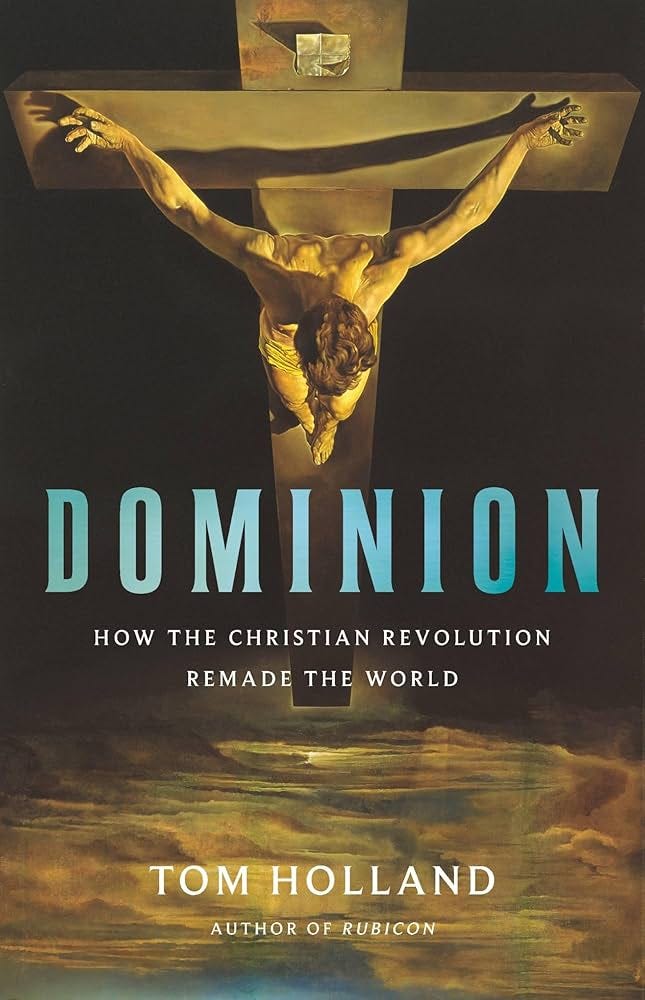
Dominion
Two recent cultural trends:
Intellectuals who had adopted an unthinking agnosticism in their youth but who now are exploring faith claims seriously, and are discovering that these claims are worthy of serious consideration. Charles Murray’s new book, Taking Religion Seriously, is the most recent example.
Agnostics and atheists surveying public affairs who are realizing that the world they’ve grown up in, which places equal value on all people and seeks to protect the vulnerable, is not an inevitable cultural assumption. In fact, it is the legacy of a culture founded on Judeo-Christian beliefs, and as those beliefs have diminishing influence, the values they underpin are threatened.
Tom Holland embodies both trends, and his book Dominion is the result. Holland is one of the best-known historians writing today, due in large part to the podcast The Rest is History, which he hosts with Dominic Sandbrook. The subtitle of Dominion is “How the Christian Revolution Remade the World.” The book is a thorough-going examination of how the human rights principles that provide the moral underpinning for our modern world are rooted in Christian teaching. We all know that Christians have violated their own principles, sometimes by applying them in ways that reflected unthinking cultural arrogance. Holland examines these issues critically and openly, but he finds that the principles themselves ultimately lead to correcting their own abuses, as people of faith sincerely explore the implications of Christ’s teaching.
Holland began his research from the posture of an agnostic; now, because of his study, he has begun to attend church regularly. Though he has not yet made a faith commitment, at least that I am aware of, he is seriously exploring a faith that, as he has come to see, is rich and profound and resonates with truth. He is an exceptionally gifted historian, and Dominion is an exceptional book.
- Jack Jr.
Early Church Fathers
This week I twice recommended a couple of books that don’t usually come up in conversation. Both collect the writings of early church fathers to give a survey of their thought. They are two books of the only books I bought for seminary that I still use regularly. Steve McKinnon’s Life and Practice in the Early Church is a remarkably helpful examination of what the early church did in worship and in their daily lives. Many of the writings we have from early church fathers are their explanations of what Christians do when they gather, so we know quite a lot about how they worshipped and what they believed.
The second is Early Church Fathers by Cyril Richardson. While McKinnon’s book is excerpts from the fathers grouped by topic, along with his explanations, Richardson’s book more straightforwardly presents complete writings from major figures like Clement, Ignatius, Irenaeus, Tertullian, and many others. Both books are easy to find and both are well worth reading. I sometimes talk with Christians who say we must get back to what the early church was like while having no idea of what that means. These books are excellent places to start.
- Jack III
Thank you both for enlightening us with your messages and giving us more food for thought Enjoy the weekend hugs