
The Good Stuff
A monk and a Jesuit walk into a Substack...


Another Side of Gerard Manley Hopkins
Gerard Manley Hopkins wrote in the final years of the 19th century. A Jesuit priest, his poetry is searchingly spiritual. He is best known for a series of so-called Dark Sonnets, which explore the lowest points of the walk of faith (one of them begins, “No worst, there is none”).
But Hopkins is miscast as a melancholy brooder, just as sadness does not define the life of faith. “God’s Grandeur” expresses wonder at the beauty of creation, and at the way it embodies spiritual truth – that after the somberness of nightfall comes the glory of morning.
This sonnet doesn’t sound like a sonnet. Hopkins aims at extreme compression in his poems; he breaks apart the rhythms of his lines, and he compresses and recreates words. You’ll hear the word “reck,” which is a shortened version of “reckon” – I share this because if you think the word is “wreck” the line makes no sense. And yet if you focus too much on the meaning, you can miss what Hopkins is doing with sound. His work exemplifies why poetry is meant to be read aloud.
- Jack Jr.
The Seven Story Mountain
While in college, I became familiar with the works of Thomas Merton. His autobiography, The Seven Storey Mountain, is one of the great spiritual works of the 20th century. In it, Merton details his gradual (and definitely not straightforward) journey to faith.
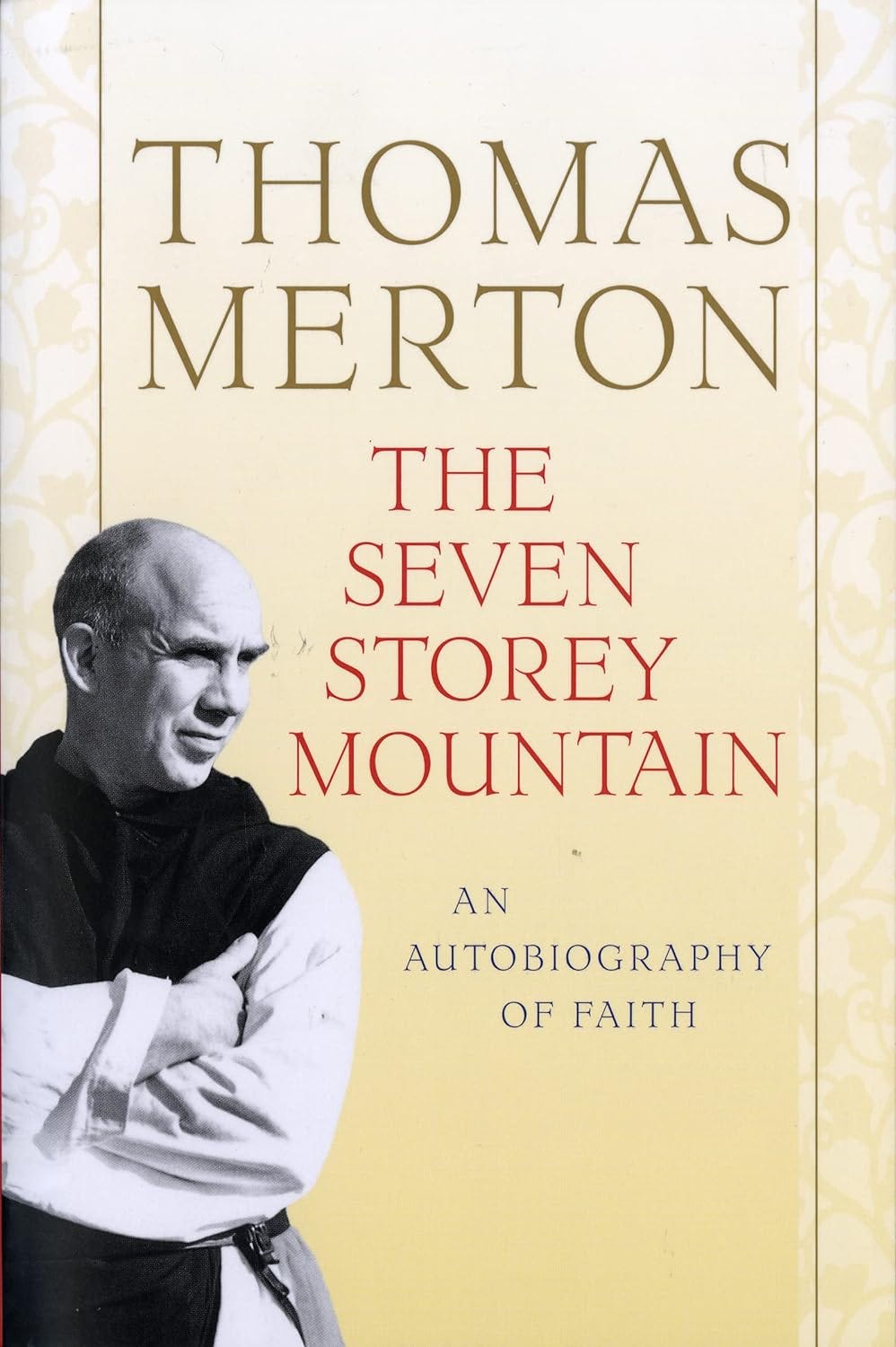
Merton’s writings (and person) have long challenged me to think beyond the Christianity I am familiar with. This is not only because Merton was a Catholic, but because, like many missionaries in the 16th century, he was very interested in Zen Buddhist practices, and how they might be applied in a Christian context.
Merton was not a tidy, simple person and struggled his entire life with certain aspects of who he was. I don’t know that I would hold him up as a shining exemplar of faith, but rather as someone whose messy journey culminated in a messy faith. That being said, the moments in The Seven Story Mountain immediately after Merton’s conversion are some of the most wonderful passages I’ve read. They show a young man eager to understand this new faith that had turned his world utterly upside down.
- Jack III
I have never read Hopkins or Merton, but this article makes me want to. I've always considered myself well read...until Jack and Jack...I now have some work to do.
Thank you both.